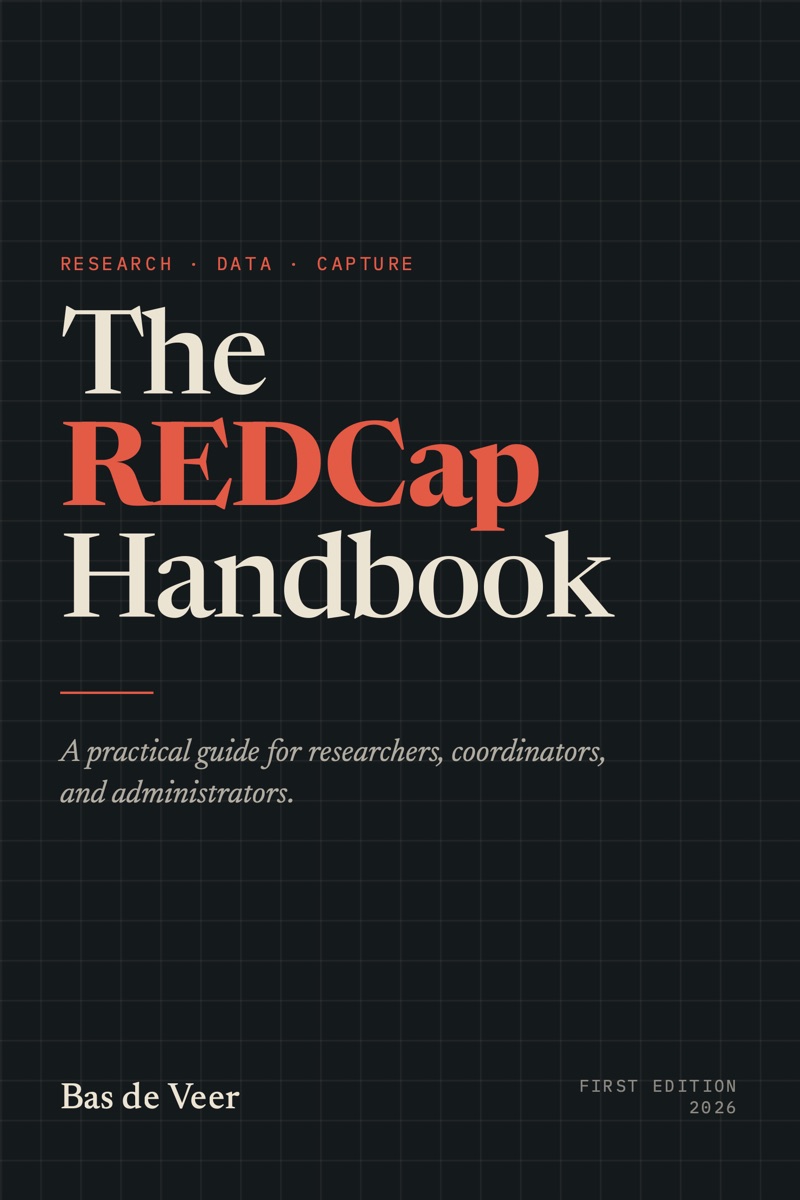
Research · Data · Capture
The REDCap Handbook
A practical guide for researchers, coordinators, and administrators.
The documentation tells you how. This book tells you why.
Why instruments are structured the way they are. Why moving a project to Production changes what you can do. Why the audit trail can’t be edited. REDCap was designed by people who understood clinical research deeply, and those choices are not arbitrary. Once you understand them, you stop fighting the software and start working with it.
Written for everyone who touches the platform: the coordinator handed a login and told to “put it in REDCap,” the analyst wondering why a single question exported as forty-seven columns, the PI who wants to know why going live suddenly got complicated, and the administrator running an installation their institution committed to without a clear sense of what that involved.
Twenty-seven chapters and five appendices cover the full arc: getting oriented, entering data, surveys, exports, and data quality; then project design, branching logic, piping, action tags, and the project lifecycle; and finally the Control Center, user management, integrations, backups, and what it actually takes to keep an installation healthy.
Editions
First edition, 2026. Available soon on Amazon.
- Paperback
- Hardcover
- Kindle ebook
How the book came together
When I started, there was no comprehensive, current book on REDCap. The training material that did exist was fragmented: institutional training pages, slide decks, recorded webinars, community forum posts, and the official documentation, which is accurate but tells you how far more often than why. Each piece answered one question, and nothing tied them together. This book is meant to fill that gap, with one place that covers REDCap from your first login to running an installation and explains the reasoning behind how it works.
It draws on years of running REDCap at the University of Washington, Wake Forest, and Yale, on training materials from more than a decade of teaching it, and on the REDCap Knowledge Base, which is updated more often than the book can be. All project examples in the book are illustrative and do not represent real studies or participants.
I used Claude, an AI assistant, extensively in making this book. It helped collate and organize material from my outlines, training notes, and knowledge base, and it drafted the manuscript text from my prompts and outlines. The cover art was also generated with Claude. I then reviewed, corrected, and edited every chapter against my own REDCap experience, and I take full responsibility for what the book says. The book’s copyright page says the same.
The book was written on personal time, using personal equipment. It is an independent publication and is not affiliated with any current or former employer.